A field pilot at the Manaseer Industrial Complex demonstrates that rice can establish and produce panicles without flooding, while corn establishes under an MNG-only soil programme with no conventional fertiliser — both under Jordan's harsh conditions.
Manaseer Industrial Complex (MIC), Jordan — August 2026.
MNG has undertaken a bold field challenge at the Manaseer Industrial Complex in Jordan: can rice and corn grow successfully under the country's harsh conditions, using the MNG soil and nutrition programme alone — without conventional flooding or conventional compound fertiliser?
The current field results are highly promising across both crops.
- Panicle emergence started four days earlier in the MNG treatment than in the control.
- At this observation stage, 17 plants in the MNG treatment had produced panicles, compared with only 4 plants in the control.
- The average internode length reached 21 cm under MNG, compared with 18 cm in the control.
- Plants are well established, actively tillering and producing panicles under visibly non-flooded field conditions.
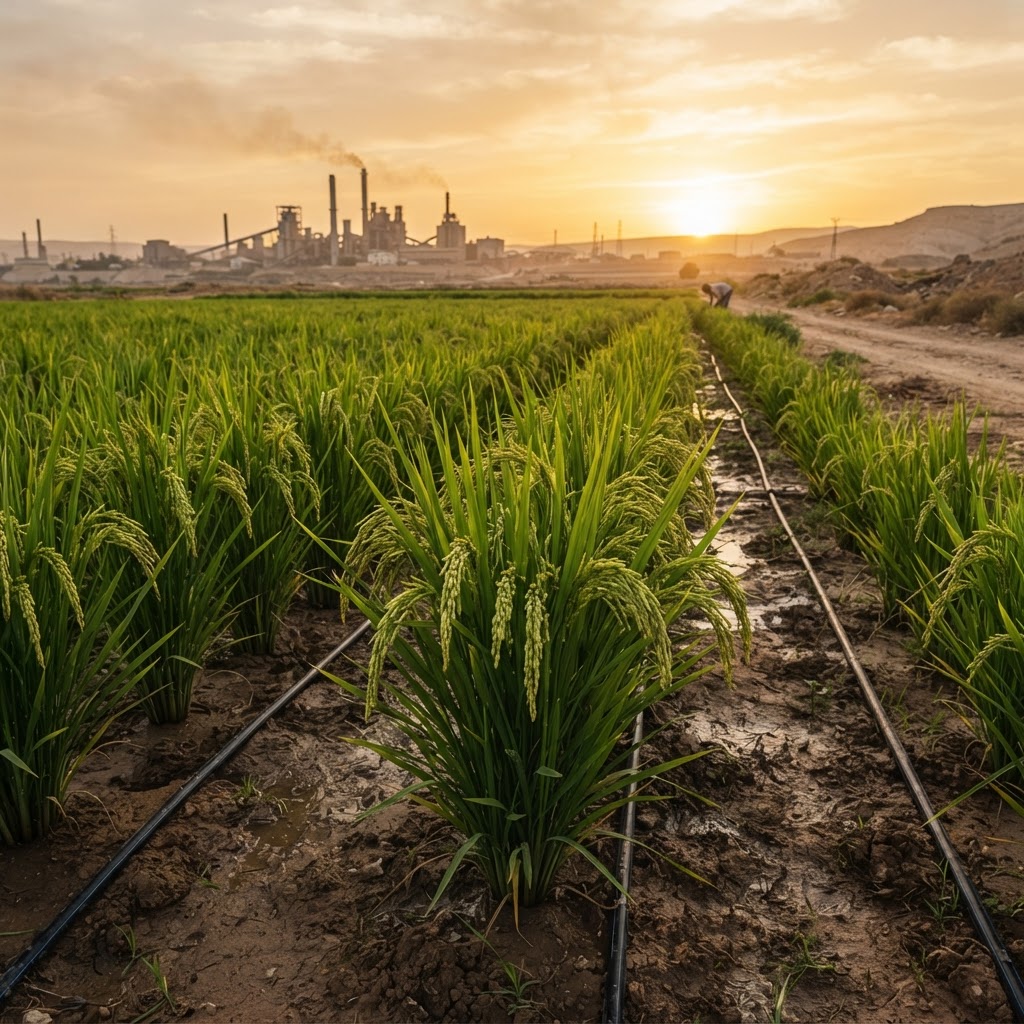
What the Photographs Document
- Rice plants are established in open, visibly non-flooded soil.
- Multiple vigorous tillers are visible within individual plant clumps.
- Panicle development is visible, confirming reproductive stage progression without standing floodwater.
- Localized irrigation lines are present, while no standing floodwater is visible.
A parallel corn trial at the same site documents early crop establishment at Day 22 under a recorded MNG-only soil programme — with no conventional compound NPK fertiliser, other conventional chemical fertiliser, compost or organic matter reported as applied up to this observation point.
Key Field Observations
- Corn plants are established along the planted rows, with visible drip lines across the field.
- Foliage appears generally green to dark green, with no widespread chlorosis or severe wilting.
- Plants are upright and actively developing leaves, although some plant-to-plant size variation is visible within the stand.
- The MNG programme combines mineral nutrition, phosphorus-efficiency and water-efficiency components within the Soil–Water–Plant framework.
Interim Assessment
The Day 22 observation documents satisfactory early corn establishment under the MNG-only soil programme. The photographs support a positive preliminary agronomic assessment. Final statements on nutrient replacement, irrigation reduction, yield and profitability will remain pending until harvest results are available.
These parallel trials are an important step for MNG and for climate-adapted agriculture in Jordan. Together they demonstrate what becomes possible when we understand the soil, water and nutritional needs of the plant and work with nature — across both a flooded-crop (rice) and a dryland-crop (corn) under the same MNG programme.
Both trials will continue to be monitored through harvest, with final yield, water consumption and grain-quality results documented and published.
Nature helps nature. Less chemistry. Better plant nutrition. Healthier food.
MNG — Nature · Science · Innovation
Update — September 2026: read the follow-up from this trial — Corn in Jordan — One Integrated MNG Programme, From Soil to Foliar.
Read the rice follow-up from this trial: Egyptian Rice in Jordan: No Permanent Flooding.